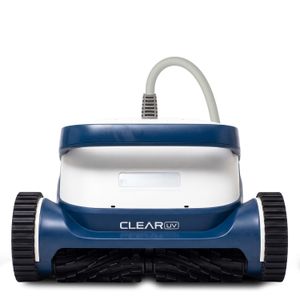
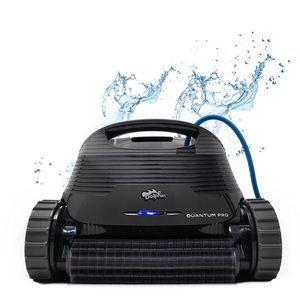
What Ultra-Fine Media Holds, and What It Cannot
Think of pool debris in three sizes. Leaves, acorns and bugs are easy: any robot basket stops them. Sand and grit are smaller but heavy enough for a standard fine panel. The third group is the one that clouds water: silt washed in by rain, pollen, wind-blown dust, and the gray-green powder left when algae dies after a shock treatment. Those particles are so light that a standard screen lets them through and the robot's own outflow lifts them back into suspension. Ultra-fine media is what breaks that loop.
It has limits. A filter only holds solids. It does nothing for water that is cloudy from chemistry, and it is no stand-in for your pool's own filter, your sanitizer, or a brush in your hand while you treat algae. Live algae on a wall has to be treated and brushed loose before any robot can collect it.
The Trade-Off: Finer Media Loads Faster
Every ultra-fine filter makes the same bargain. The pores that hold silt also fill with it, and as they fill, flow through the robot drops. A robot with a loaded fine filter moves less water, collects less, and can struggle to hold a wall. It is the filter doing its job and asking to be rinsed, so the routine is simple and not optional:
- Rinse fine panels or cartridges after every cycle, while they are still wet. Dried silt sets hard.
- Use a garden hose at normal pressure, not a pressure washer or a stiff brush.
- Swap to the standard or coarse media before a leaf-heavy clean, then swap back for the polish.
Getting the Most From Ultra-Fine Filters
- Net or skim the big debris first. Ultra-fine media should meet silt and pollen, not a layer of wet leaves that blinds it in the first ten minutes.
- Shorten the gap between cycles in pollen season. A timer or app schedule keeps each load light, so the filter never reaches the point where flow collapses.
- After an algae treatment, wait until the water chemistry is back in range, brush the walls, then run the fine filters and rinse them the moment the cycle ends.