Black Friday SaleFree US shipping on every order
(888) 895-7080
Free Shipping Low Price Guarantee 30-Day Trial & Easy Returns
Free Shipping Low Price Guarantee Speak to a Pool Expert
Free 1–3 Day Shipping on Pool Robots Low Price Guarantee 30-Day Trial & Easy Returns

Buying Guide · Debris and Dirt Problems

Best Robotic Pool Cleaner for Silt: Ultra-Fine Filters and Patience

Silt is too fine for a standard filter and too light to stay put, so clearing it takes ultra-fine media, still water and more than one cycle.

By the SpectraLight pool experts · Updated November 2026

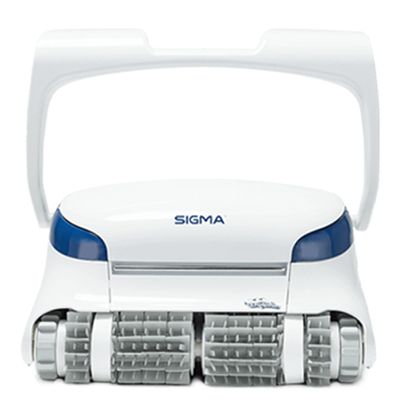
Dolphin Sigma robotic pool cleaner

The Short Answer

Our first pick for silt is the Dolphin Sigma, which includes NanoFilters, scrubs the film loose with four brushes and alerts you in its app when the filter needs rinsing. The Dolphin Premier follows closely with NanoFilters and a timer for daily passes. Whichever you choose, let the silt settle with the pump off first, and expect several cycles after a flood or dust event.

Silt is the finest solid most pools ever have to deal with: mineral particles smaller than sand, washed in by runoff, blown in as dust or left behind by floodwater. It does not sink so much as drift down. Given a still night it settles as a smooth tan or gray film, and the first swimmer or brush sends it billowing up again. The best robotic pool cleaner for silt has to trap particles that a standard filter passes straight through.

In the water, silt is what turns clear blue to a flat, milky gray-green. On the surfaces, it leaves a film on steps and walls and a line at the water's edge. Clearing it is slower than any other cleanup we write about, and we would rather tell you that now. The robots below can do it, given ultra-fine media, still water and repeated cycles.

Our Picks, in Order

Our Picks for a Silted Pool

Every price below is today’s price in our store.

  1. Pick 1: Best for Silt: Alerts, NanoFilters, Four Brushes

    Dolphin Sigma

    Silt is a filter-management job, and the Sigma manages it best. NanoFilters are included, and the myDolphin Plus app sends a filter alert when they have loaded, so you rinse and restart instead of letting the robot run blind. Its four scrubbing brushes loosen the settled film on floor, walls and tile line, while three commercial-grade ProLine motors pull 4,500 gallons per hour through the fine media. The scheduler sets each cycle by day and time, and its 3-year warranty is described as having no cycle-count limit.

    Best for
    In-ground pools up to 50 ft recovering from runoff, flood or dust, with an owner who will act on phone alerts.
    Keep in mind
    The price is the steepest of the five. If you would rather not depend on a phone, our second pick's filter light does the same job more simply.
    See the Dolphin Sigma
  2. Pick 2: Daily Timed Passes With NanoFilters Included

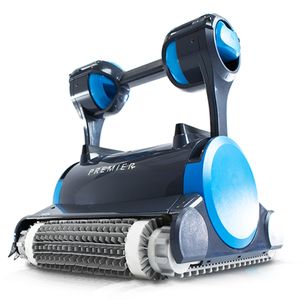
    Dolphin Premier

    The Premier's answer to silt is persistence. Set the weekly timer on the power supply to every day and it takes a 3-hour pass at the floor, walls and waterline without being asked. NanoFilters come in its Multi-Media set and lift out from the top with no tools for the rinse between cycles, and the full-filter indicator on the power supply shows when they have loaded. Dual scrubbing brushes and 4,500 gallons per hour from dual commercial-grade ProLine motors do the lifting.

    Best for
    Owners who want the cleanup to repeat itself daily with no phone involved.
    Keep in mind
    You have to walk to the power supply to see the filter light, and with silt you should check it during every cycle.
    See the Dolphin Premier
  3. Pick 3: 1-Micron Panels and a Three-Hour Ultra Mode

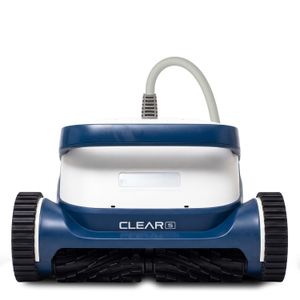
    Clear S

    The Clear S carries the only stated micron rating on this page, 1-micron panels in its UltraFilter basket, and the flow to use them: more than 8,500 gallons per hour from two pump motors. Its modes map neatly onto a silt cleanup. Start with Floor only over the settled layer, use the three-hour Ultra mode for the main passes, and finish with Waterline only for the line silt leaves at the tile. Front and rear active scrubbing brushes work the film loose.

    Best for
    In-ground pools up to 50 ft whose owners want to choose a mode for each stage of the cleanup.
    Keep in mind
    Panels this fine load quickly under silt. Plan to rinse them between every cycle, not just when pickup falls off.
    See the Clear S
  4. Pick 4: Clear S Filtration With a Built-In UV-C Light

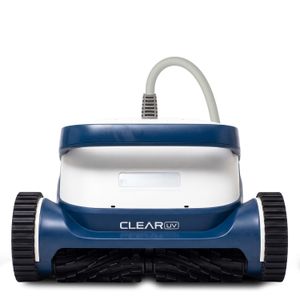
    Clear UV

    The Clear UV handles silt exactly as the Clear S does, because the filtration, flow, brushes and modes are shared: fine panels rated at 1 micron, flow above 8,500 gallons per hour from two pump motors, active brushes front and rear, and the same six cleaning modes in the Clear app. It adds a built-in UV-C light controlled from the app, and it costs more. We rank it just behind its twin because the light is not part of silt removal, so the lower-priced Clear S is the better value here.

    Best for
    Owners who want the light and would otherwise choose the Clear S.
    Keep in mind
    Do not expect a faster silt cleanup than the Clear S gives. Compare the live prices.
    See the Clear UV
  5. Pick 5: Value Pick That Reaches Silted Steps and Shelves

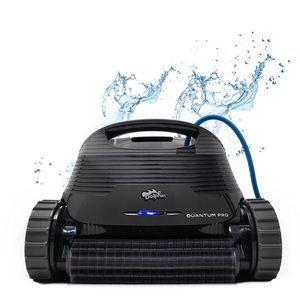
    Dolphin Quantum

    Silt shows worst in shallow water, as a film on steps, sun shelves and Baja ledges, and the Dolphin Quantum is the pick here that cleans all three as well as the floor, walls and waterline. A full set of NanoFilter panels is included. They ride in the XXL MaxBin, with over 400 square inches of filter area, which opens from the top with one click for the rinse between cycles. Dual HyperBrushes spin at twice the speed of standard brushes, and cycles repeat from the weekly timer or the app.

    Best for
    Pools with shallow steps and ledges where the silt film is most visible, bought on a budget.
    Keep in mind
    Flow of 4,000 gallons per hour and a 2-year warranty put it behind the four picks above for a long, repeated cleanup.
    See the Dolphin Quantum

What Matters

What Silt Asks of a Robot, and of You

01

Ultra-Fine Filtration, Nothing Less

Silt particles are far smaller than the openings in a standard panel or cartridge, so they go in the intake and straight back out. Only ultra-fine media holds them. That is why the Cayman and Escape, whose NanoFilter panels are an optional add-on, are not picks here: without those panels they mostly stir silt.

02

Brushes for the Film

Settled silt clings lightly to floors, walls and steps. Active brushes lift that film into the robot's flow so it reaches the filter. Waterline cleaning counts too, because silty water leaves a line at the tile.

03

A Prompt When the Filter Is Loaded

Silt loads ultra-fine media faster than anything else, and a loaded filter stops collecting long before the cycle ends. A filter alert on your phone, or a full-filter light on the power supply, tells you when to rinse and restart.

04

Stamina for Many Cycles

After a flood or a dust event, several cycles over a few days is normal. Look for scheduling that repeats without your attention, quick filter access, and a warranty that does not count cycles.

Side by Side

The Five Silt Picks Compared

Specification Dolphin Sigma Dolphin Premier Clear S Clear UV Dolphin Quantum
Price today $2349 $1949 $1749 $1999 $1599
Filtration NanoFilters and standard filter cartridges Multi-Media: NanoFilters, oversized leaf bag and standard fine filters UltraFilter basket: 1-micron fine and 180-micron coarse panels UltraFilter basket: 1-micron fine and 180-micron coarse panels XXL MaxBin basket with standard and NanoFilter panels
Filter access Cartridges Top-load, no tools — — Top-load, one-click open
Brushes Quad scrubbing brushes Dual scrubbing brushes Front and rear active brushes Front and rear active brushes Dual HyperBrush
Flow rate 4,500 GPH 4,500 GPH 8,500+ GPH 8,500+ GPH 4,000 GPH
Cycle time 2.5 hours 3 hours 1, 2 or 3 hours (six modes) 1, 2 or 3 hours (six modes) 2 hours
Cleans Floor, walls and waterline Floor, walls and waterline Floor, walls and waterline Floor, walls and waterline Floor, walls, waterline, sun shelves and stairs
Scheduling Weekly scheduler by day and time Weekly timer: every day, every 2 days or every 3 days Weekly schedules in the Clear app Weekly schedules in the Clear app Weekly timer: every day, every 2 days or every 3 days
Warranty 3 years 3 years 3 years (limited) 3 years (limited) 2 years
Shop Buy the Dolphin Sigma Buy the Dolphin Premier Buy the Clear S Buy the Clear UV Buy the Dolphin Quantum

How To Clear Silt With a Robot

Silt punishes haste. The method below looks slow, but it is quicker than chasing a cloud around the pool for a week.

  • Turn the pump off and leave the pool alone for several hours, ideally overnight. Still water lets silt settle into a layer on the floor.
  • Make the first pass a gentle one. Lower the robot in slowly at one end, with ultra-fine media installed, and do not brush or swim beforehand.
  • Rinse the filter as soon as the cycle ends, or sooner if you get a filter alert.
  • Let the water go still again, then repeat. Each cycle takes another layer.
  • Once the floor stays clean overnight, restart the pump, clean the pool filter and return to your normal schedule.

When Flocculant and Vacuum-to-Waste Are the Better Route

A robot is the right tool for a film of silt, or for the tail end of a bigger cleanup. It is not the fastest tool for a pool that has taken floodwater and turned opaque. For that, the established route is chemical: a clarifier to help the pool filter catch fine particles, or a flocculant that binds them into heavy clumps that sink within hours. The settled sludge is then removed with a manual vacuum set to waste, bypassing the filter. Do not send a robot into flocculated sludge. Use it afterward, with ultra-fine media, to polish what the vacuum missed.

Where Silt Comes From, and How To Slow It

Silt needs a route into the pool, and most routes can be narrowed. Runoff is the main one: a deck that slopes toward the water, a bare bank above the pool or a downspout that discharges nearby will deliver silt with every heavy rain. Plant or mulch bare soil, and add a drain channel if water sheets across the deck. Wind is the second route, especially in dry or newly built neighborhoods, and a cover on the pool during dust events saves days of cleanup.

Silt Tips Worth Knowing

  1. Keep swimmers out between cycles if you can. Every swim lifts the settled layer back into the water.
  2. Rinse ultra-fine filters until the runoff is clear, then once more.
  3. Clean or backwash the pool's own filter midway through the cleanup. It is loading up at the same rate as the robot.
  4. After a flood, test the water and restore its balance before you worry about the last of the film.


SpectraLight pool experts, Mon to Fri 8am to 5:30pm CST

Not sure which robot fits your pool?

Tell a SpectraLight pool expert your pool’s size, surface and what ends up in it, and get a straight answer before you buy.

Call (888) 895-7080

Silt Questions and Answers

What is the difference between silt and sand in a pool?

Size and behavior. Sand grains are visible, gritty and sink at once. Silt is far finer, feels smooth or floury between the fingers, hangs in the water for hours and settles as a film that clouds up when touched. Sand needs suction and capacity. Silt needs ultra-fine filtration and still water.

Will a clarifier help my robot pick up silt?

It can. A clarifier gathers fine particles into slightly larger clumps, which are easier for the pool filter and for a robot's ultra-fine media to hold. Follow the product label and take the robot out while you add chemicals. Flocculant is different: it is meant for vacuum-to-waste, not for robots.

Is the best robotic pool cleaner for silt still worth having once the silt is gone?

Yes. The ultra-fine media that traps silt also traps pollen, dust and dead algae, so the same robot keeps the water polished all year. Switch to the standard media when leaves are falling and return to the fine set afterward. The scheduling and waterline scrubbing you paid for are everyday benefits too.

How long does it take to clear silt after a flood?

Plan on days, not hours. Several robot cycles with rinses in between is normal, and a heavily silted pool may need flocculant and vacuum-to-waste first. Progress shows as each morning's film getting thinner. If it is not thinning, more silt is arriving or the filter media is too coarse.

The Verdict

The Honest Summary on Silt

No robot clears silt in one run, and none clears it at all without ultra-fine media. With that understood, the Sigma is our first choice for its filter alerts and four brushes, the Premier for daily timed passes, the Clear S and Clear UV for 1-micron panels and staged modes, and the Quantum for shallow steps and the lowest price of the five. Settle, run, rinse, repeat. If your pool is opaque after a flood, chat with a pool expert before you buy, because flocculant may need to come first.