Black Friday SaleFree US shipping on every order
(888) 895-7080
Free Shipping Low Price Guarantee 30-Day Trial & Easy Returns
Free Shipping Low Price Guarantee Speak to a Pool Expert
Free 1–3 Day Shipping on Pool Robots Low Price Guarantee 30-Day Trial & Easy Returns

Buying Guide · Steps, Ledges and Tricky Features

Best Robotic Pool Cleaner for Sloped Pools: Which Robots Hold Their Line

The slope is where silt pauses on its way to the deep end, and where a robot with a poor sense of direction wastes its cycle. These five do better.

By the SpectraLight pool experts · Updated November 2026

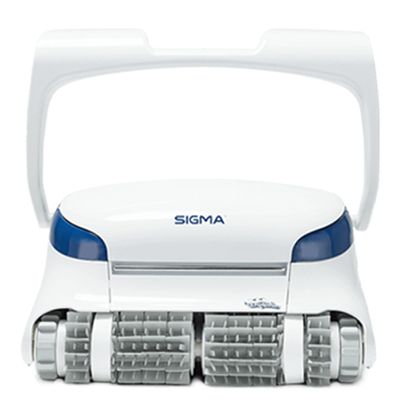
Dolphin Sigma robotic pool cleaner

The Short Answer

Our top pick for a sloped pool is the Dolphin Sigma, whose onboard gyroscope senses the incline and keeps the robot on its line instead of drifting back to the low point. The Dolphin Premier is the runner-up: no gyroscope, but a 3-hour cycle and HyperGrip tracks give it the time and grip for a standard slope. On a tighter budget, the Dolphin Quantum does it in 2 hours.

Every pool with a shallow end and a deep end has a ramp between them, and that ramp is the most overlooked surface in the water. Fine dust settles on it mid-journey and leaves a dull band you only notice when the sun is low. Brush it and a cloud rolls downhill. The best robotic pool cleaner for sloped pools lifts that film where it lies, on the way up as well as the way down.

Grip is rarely the problem, because tracks take a normal break in stride. Direction is. A robot that loses its heading on the incline slides to the low point and spends the cycle polishing the deep end. We ranked five robots on how well they hold a line, with the Clear S and the Dolphin Cayman completing the list. If you are after the best robotic pool cleaner for steep slopes, such as a hopper bottom, we cover that below.

Our Picks, in Order

Our Picks for Sloped Pools

Every price below is today’s price in our store.

  1. Pick 1: Holds Its Line on the Incline

    Dolphin Sigma

    The Sigma leads for one reason above the rest: SmartNav 3.0 has an onboard gyroscope, so the robot senses the incline. It keeps its heading across the break instead of sliding back down. That is the difference between a slope cleaned in passing and a slope cleaned on purpose.

    Three ProLine motors and HyperGrip tracks supply the push for the climb, quad brushes scrub the film where it rests, and the included NanoFilters hold the dust that made it.

    Best for
    Pools up to 50 ft with a long or pronounced break, hopper bottoms and sport-pool floors.
    Keep in mind
    Highest price of the five, and its weekly scheduler lives in the app, so plan on using a phone.
    See the Dolphin Sigma
  2. Pick 2: Three Hours to Cover Every Strip

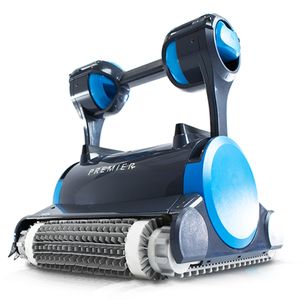
    Dolphin Premier

    On a standard transition slope a robot can do without tilt sensing, provided it has grip and time. The Premier pairs SmartNav 2.0 scanning with HyperGrip tracks, then adds the thing that forgives an imperfect line: a 3-hour cycle, the longest of the Dolphins in this guide.

    The 360-degree swivel on its 55 ft cable keeps twist from tugging it downhill, and its power-supply timer can be set to daily, every 2 days or every 3 days.

    Best for
    Standard shallow-to-deep pools where leaves and silt both end up on the ramp.
    Keep in mind
    On a very long or steep slope it leans on repeat passes rather than tilt sensing, and it has no phone control.
    See the Dolphin Premier
  3. Pick 3: Tilt-Aware Navigation That Learns the Pool

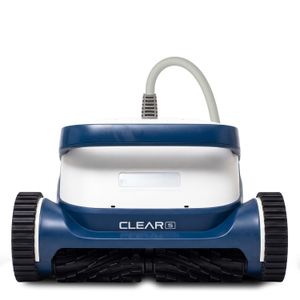
    Clear S

    The Clear S is the other robot here that measures tilt rather than inferring it. A gyroscope and an accelerometer work together, and coverage tightens after two or three cycles as it gets to know the pool, slope included. Front and rear scrubbing brushes mean it is working the surface whichever way it faces on the incline, backed by 8,500+ GPH of flow from twin pump motors.

    It ranks third because the Sigma's quad brushes and swivel cable make a more complete package for this job.

    Best for
    App-minded owners who want tilt sensing and a 1-micron fine filter in a pool up to 50 ft.
    Keep in mind
    Its first couple of cycles are its least efficient, so judge it after a week, and compare the live price with the Premier and Quantum.
    See the Clear S
  4. Pick 4: Best Value for an Ordinary Slope

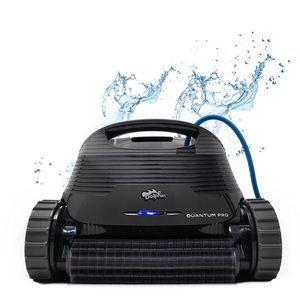
    Dolphin Quantum

    The Quantum handles a normal shallow-to-deep break the way the Premier does, by scanning and grip, and brings two things of its own. Its HyperGrip tracks are continuous rubber, and its dual HyperBrush spins at twice the speed of standard brushes, which lifts settled film quickly on a surface the robot crosses in seconds.

    At 18.3 lb it is the lightest 50 ft Dolphin in this guide, with an anti-tangle swivel on a 55 ft cable.

    Best for
    Pools of 34 to 50 ft with an everyday slope, when the Premier is more than the budget allows.
    Keep in mind
    No tilt sensing and a 2-hour cycle, so a long hopper may need runs every day. The warranty is 2 years.
    See the Dolphin Quantum
  5. Pick 5: The Pick for Sloped Pools Up to 33 ft

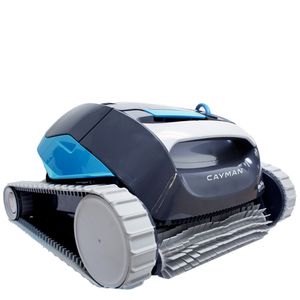
    Dolphin Cayman

    Smaller pools have slopes too, and for those the Cayman is the sensible buy. It drives on HyperGrip tracks, scans with SmartNav 2.0 and scrubs with one HyperBrush at twice the speed of a standard Dolphin brush, while dual 24-volt DC motors move over 4,000 GPH.

    It is rated for in-ground and above-ground pools up to 33 ft. The timer has a single setting, every day, and that suits a slope well: daily passes never give film the chance to settle.

    Best for
    In-ground or above-ground pools up to 33 ft with a gentle to moderate slope.
    Keep in mind
    Floor and walls only, with no waterline cleaning, and the 50 ft cable has no swivel, so untwist it now and then.
    See the Dolphin Cayman

What Matters

What a Slope Asks of a Robot

01

Knowing Which Way Is Up

On a flat floor a robot can steer by scanning alone. On an incline, gravity keeps nudging it toward the deep end. A gyroscope measures tilt and rotation directly, so the robot can correct. The Sigma has one, and the Clear robots pair a gyroscope with an accelerometer.

02

Grip for the Return Climb

Coming back up with a loaded basket takes traction. Every Dolphin in this guide drives on HyperGrip tracks, which spread contact along the robot's length. A clean filter counts too, since a clogged one cuts the water flow the robot depends on.

03

Enough Cycle for Repeat Passes

A robot that drifts off line once will often catch the missed strip later, if the cycle is long enough. The Premier runs 3 hours and the Sigma 2.5, against 2 for the Quantum and Cayman.

04

A Cable That Does Not Steer

A twisted cable pulls sideways, and on a slope a sideways pull becomes a downhill slide. The Sigma, Premier and Quantum each have a swivel on a 55 ft cable, and the Clear S has a 59 ft anti-tangle cable.

Side by Side

The Five Robots Compared

Specification Dolphin Sigma Dolphin Premier Clear S Dolphin Quantum Dolphin Cayman
Price today $2349 $1949 $1749 $1599 $1049
Cleans Floor, walls and waterline Floor, walls and waterline Floor, walls and waterline Floor, walls, waterline, sun shelves and stairs Floor and walls
Traction HyperGrip tracks HyperGrip tracks — HyperGrip tracks HyperGrip tracks
Navigation SmartNav 3.0 with gyroscope SmartNav 2.0 Gyroscope and accelerometer SmartNav 2.0 SmartNav 2.0
Working depth — — 2.5 to 16.4 ft — —
Cable 55 ft with 360° anti-tangle swivel 55 ft with 360° anti-tangle swivel 59 ft anti-tangle 55 ft with anti-tangle swivel 50 ft
Robot weight 24.6 lb 20.3 lb — 18.3 lb 14.6 lb
Warranty 3 years 3 years 3 years (limited) 2 years 2 years
Shop Buy the Dolphin Sigma Buy the Dolphin Premier Buy the Clear S Buy the Dolphin Quantum Buy the Dolphin Cayman

Steep Slopes, Hopper Bottoms and Sport Pools

A hopper bottom is a deep well with sharply angled sides, common in vinyl diving pools. Past a certain pitch a robot stops treating those sides as floor and climbs them as walls: up, scrub, back down. Robots that clean walls and hold a heading do this best, so the order above stands.

In a vinyl pool, check that the liner sits tight on the steep faces first. A loose liner on a pitch can stall a robot, and that is a liner repair, not a robot setting. A sport pool with a V-shaped floor is simpler: two mild slopes meeting in the middle, with the silt gathering at the low point.

Why a Robot Keeps Ending Up in the Deep End

If the shallow end stays dusty while the deep end shines, check these before you blame the slope.

  • A twisted cable. Twist shortens the cable and drags the robot off line. Lay it straight on the deck and let the kinks relax.
  • A full filter. Reduced water flow shows up first as a weak climb.
  • A slick ramp. An early algae film is slippery. Brush it, balance the water, then run the robot.
  • A power supply at the shallow end only. If the cable is taut at the bottom, the robot is fighting it all cycle.

Two Robots We Left Off the List

The Clear UV shares the Clear S navigation, brushes and flow, so it is just as capable on a slope. It adds a built-in UV-C light controlled from the Clear app at a higher price, which is why the S takes the slot. The Escape also copes with an everyday slope in a pool up to 33 ft, using the same tracks, motors and HyperBrush as the Cayman in a 1.5-hour cycle. Measure its 40 ft cable against your pool first. We prefer the Cayman for small sloped pools because of its 50 ft cable and daily timer.

Getting a Clean Slope Every Cycle

  1. Set the power supply about midway along the pool or toward the deep end, so the cable is never taut when the robot is at the bottom of the slope.
  2. Rinse the filter before the pool looks dirty. On a slope, a clean filter is traction as much as filtration.
  3. If you can, switch the circulation pump off during the cycle, so the return jets are not pushing fine dust back down the ramp behind the robot.
  4. After the first week, look at the break in low sun. An even ramp says the robot is holding its line; a striped one says shorten the gap between runs.


SpectraLight pool experts, Mon to Fri 8am to 5:30pm CST

Not sure which robot fits your pool?

Tell a SpectraLight pool expert your pool’s size, surface and what ends up in it, and get a straight answer before you buy.

Call (888) 895-7080

Sloped Pool Questions

Can a robotic pool cleaner climb from the deep end back up to the shallow end?

Yes. A normal transition is well within what a tracked robot handles, and every pick here climbs full walls, which are far steeper than any floor. When a robot fails to come back up, the cause is nearly always a twisted cable, a full filter or a slippery film on the ramp.

Would the best robotic pool cleaner for sloped pools be a different pick for a flat floor?

It can be. On a flat floor, navigation differences show up as efficiency. On a slope they show up as missed areas, because gravity pulls an unsure robot toward the low point. That is why the tilt-sensing Sigma and Clear S rank higher here than they might in a flat play pool.

Will a robot clean the steep sides of a vinyl hopper-bottom pool?

It will treat them as walls: climb, scrub and descend. Vinyl liner is a published surface for all four Dolphins in this guide. Before the first run, make sure the liner sits tight on the steep faces, because a loose liner on a pitch can stall any robot.

Does a sport pool with two shallow ends need a different robot?

No. Its floor dips to a shallow V in the middle, and any pick here handles it. Choose by length instead: the Sigma, Premier, Clear S and Quantum cover pools up to 50 ft, the Cayman up to 33 ft.

The Verdict

How to Choose for Your Slope

Match the robot to the pitch and the pool length. A long, steep or hopper-style slope calls for tilt sensing: the Sigma first, the Clear S as the alternative. An ordinary break in a full-size pool is well served by the Premier's 3-hour cycle or, for less money, the Quantum on a frequent timer. In a pool of 33 ft or less, the Cayman's daily run keeps the ramp dusted. Every order ships free.