Why Swim-Outs Stay Dirty
Three things work against a swim-out. The first is circulation: the recess is out of the path of the returns, so whatever floats in is not carried out again. The second is geometry: the seat meets the back and side walls in tight inside corners, where leaves wedge and algae starts. The third is position. Most swim-outs are at the deep end, the farthest point from the skimmer. A robot helps with the second and third. It does nothing for the first, which is why a swim-out can look neglected in an otherwise clean pool.
Cleaning the Seat Itself
Plan on brushing the seat, and treat anything the robot does up there as a bonus. Before a cycle, sweep the seat and step toward open water so everything drops to the floor below. Work the back corner first, since that is where leaves pack. Then run the robot, with a coarse filter or leaf bag if you swept out a pile and a fine filter for the follow-up. In fall, do this weekly. A robot does not replace the skimmer, the brush or your sanitizer. It collects what they loosen.
Where the Escape and Clear S Stand
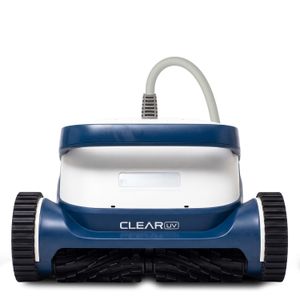
The Escape is not a match for this job. It publishes no obstacle list, does not clean the waterline, and its 40 ft cable is a real constraint when the swim-out is at the deep end. The Clear S is the Clear UV without the UV-C light, at a lower price, with the same joystick driving, the same modes and the same 2.5 ft minimum working depth. If the light is not important to you, the S does everything the UV does around a swim-out.
Swim-Out Care in Four Moves
- Sweep the seat and step toward open water before each robot cycle, starting in the back corner.
- Aim a return jet toward the swim-out if your fittings swivel. Even a little flow keeps leaves from settling in the recess.
- Stand the power supply nearer the end of the pool where the swim-out is, at the setback in your manual, so the cable has slack to climb there.
- After windy days, check the alcove before you run the robot. A pile caught early is a rinse; a pile left a month is a stain.