Looks In-Ground, Built Above-Ground: Why It Matters
The wall of a semi-inground pool is a panel, not a poured shell, and the liner sits on a troweled base that is softer than gunite. Robots published only for in-ground pools are described around that heavier construction. The Premier, Sigma and Quantum are not listed for above-ground-style pools, and Clear S and Clear UV are rated for in-ground residential pools only, so none of them is a recommendation here, however in-ground the pool looks once the pavers are down.
Size is the other difference. The 50 ft machines are built for long pools with real deep ends, and you would be paying for reach and cycle time that a 24 ft round holding four feet of water cannot use.
Measure the Cable Run Before You Choose
Cable reach is a separate check from the length rating, and on a decked pool it is the one that catches people out. The power supply sits back from the water's edge by the distance your manual gives, and from there the cable must still reach the farthest point of the floor.
Take a 15 by 30 ft pool with the power supply beside the middle of a long side. Using roughly 12 ft of setback purely as an example (substitute the figure in your own manual), add about 4 ft down to the floor and about 21 ft across to a far corner, and you are near 37 ft. A 40 ft cable does that with almost nothing spare. A 50 ft cable does it with slack, which matters more when there is no swivel to shed twists.
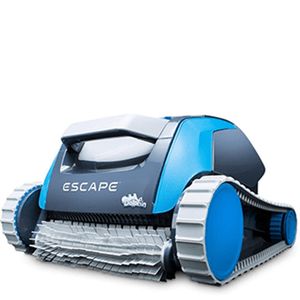
- On a round pool the far point is a full diameter away. A 24 ft round with the same example setback already uses about 40 ft, which is why we ask Escape buyers with larger rounds to measure first.
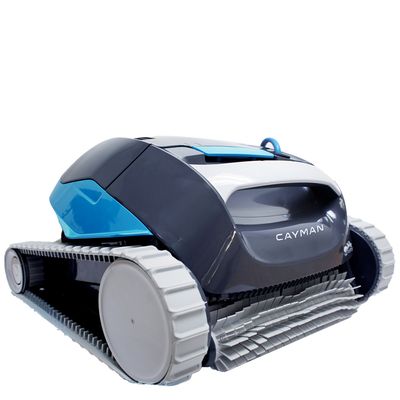
- If the deck layout forces the power supply farther back, the Cayman is the safer choice.
What Settles in the Pool, and What the Robot Leaves
A semi-inground pool takes in what a taller above-ground pool is spared: soil washed off the lawn in a storm, mower clippings, dust from a gravel path. There is rarely a main drain, so nothing pulls that material off the floor. It lies on the liner as a gray film, lifts into the water when people swim and settles again overnight. Run a robot regularly and that loop ends, because the dirt leaves the pool in a MaxBin basket 50% larger than standard Dolphin filters. For the finest dust, NanoFilter panels are an optional add-on for either robot.
Be clear about the limits. Neither pick scrubs the waterline, so the ring that sunscreen and pollen leave at the surface is still a job for a sponge. And a robot does not replace sanitizer or the skimmer. It handles what sinks.
If Your Pool Is Longer Than 33 Feet
Some semi-inground models run long: ovals and rectangles of 36 or 40 ft and more. Those sit outside the 33 ft rating of both picks, and a robot working past its rating may not cover the far end in its cycle. The 50 ft in-ground robots have the reach, but they are not listed for above-ground-style construction, and we are not going to tell you otherwise on a web page. Chat with a pool expert with the pool's make, wall type, length and depth, and we will say plainly what we would and would not put in it.
Getting a Robot Running in a Semi-Inground Pool
- Before the first cycle, walk the floor and note any liner wrinkles or soft spots in the base, then watch how the robot crosses them.
- Stand the power supply on the deck at the midpoint of the longest side, set back by the distance in the manual, so the cable reaches both ends equally.
- Empty the basket after storms and after mowing days, not just weekly. Clippings and silt mat together and choke the flow.