Black Friday SaleFree US shipping on every order
(888) 895-7080
Free Shipping Low Price Guarantee 30-Day Trial & Easy Returns
Free Shipping Low Price Guarantee Speak to a Pool Expert
Free 1–3 Day Shipping on Pool Robots Low Price Guarantee 30-Day Trial & Easy Returns

Buying Guide · Pool Shape and Design

Is There a Best Robotic Pool Cleaner for Lazy Rivers? The Nearest Fits

A backyard lazy river can be robot-cleaned one section at a time with the current off; a resort river cannot, and we would rather say so now.

By the SpectraLight pool experts · Updated November 2026

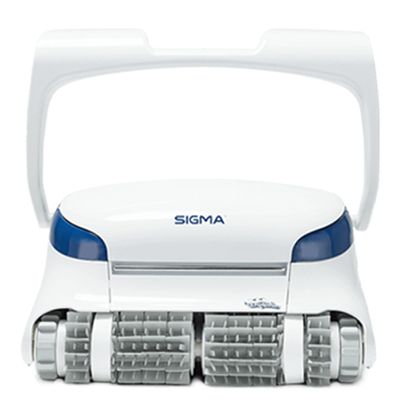
Dolphin Sigma robotic pool cleaner

The Short Answer

Nothing here is designed for a lazy river, so this is a nearest-fit answer for small backyard rivers. We would start with the Dolphin Sigma: a 55 ft swivel cable that sheds the twist of constant turns, gyroscope navigation, and waterline cleaning for two close walls. The Premier is the alternative when leaves are the main load. Either one cleans a section at a time, with the current off.

Before You Buy

No robot in this guide is designed for a lazy river. The three below are the nearest fits for a small backyard river only, cleaned one section at a time with the current off, because a 55 to 59 ft cable reaches part of a loop and not all of it. Resort and water-park rivers need commercial equipment, so talk to us first.

A lazy river asks more of its water than any pool does. The channel is long, shallow and all edge: two walls a few feet apart, a wide surface for sun and wind to work on, and a current that keeps fine debris moving until the pump stops and it settles in drifts on the inside of every bend. Keeping that clear is real work, which is why owners go looking for the best robotic pool cleaner for lazy rivers.

The straight answer is that there is not one, not among the robots in this guide and not for a river that runs hundreds of feet around a resort. What does work is narrower: a backyard river with a channel wide and deep enough for a robot to turn in, cleaned in sections with the current off. For that job Clear S joins our top two as the third nearest fit.

Our Picks, in Order

The Three Nearest Fits for a Backyard Lazy River

Every price below is today’s price in our store.

  1. Pick 1: Nearest Fit for a Backyard River Section

    Dolphin Sigma

    If we had to put one robot in a backyard river, it would be the Sigma. Its 55 ft cable carries a 360-degree anti-tangle swivel, which is what keeps a robot working through the nonstop turns of a channel. SmartNav 3.0 with its onboard gyroscope gives the best chance of orderly passes along a curving run, though no navigation here was written for a loop.

    Quad scrubbing brushes cover the floor, both walls and the waterline, which matters when two walls sit a few feet apart, and three commercial-grade ProLine motors pull 4,500 gallons an hour through the included NanoFilters to lift the fine sediment a current leaves behind.

    Best for
    Backyard rivers with a channel wide enough to turn in, where settled fines and wall film are the main problem.
    Keep in mind
    At 24.6 lb it is the heaviest Dolphin here to carry from section to section, and the highest-priced pick.
    See the Dolphin Sigma
  2. Pick 2: Nearest Fit When the River Fills With Leaves

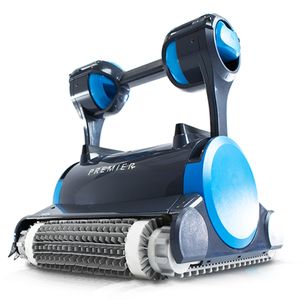
    Dolphin Premier

    The Premier shares the feature that counts, a 55 ft cable with a 360-degree anti-tangle swivel, and adds the right filter for a landscaped river. Its Multi-Media system includes an oversized leaf bag alongside NanoFilters and standard fine filters, swapped from the top in seconds, so the same robot handles a stretch buried in leaves and then a stretch of fine silt.

    The 3-hour cycle gives each section a long working pass. Everything is controlled on the power supply, which is where you will be standing anyway, and at 20.3 lb it is lighter to carry than the Sigma.

    Best for
    Tree-lined or heavily planted backyard rivers where leaf volume, not fine dust, is what stops the cleaning.
    Keep in mind
    Scanning navigation without a gyroscope, and dual brushes rather than four. Like the others, it cleans one section per run.
    See the Dolphin Premier
  3. Pick 3: Nearest Fit With Joystick Steering

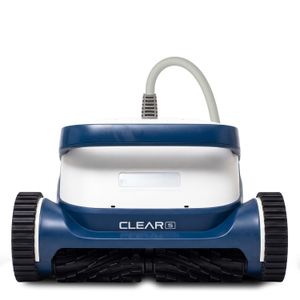
    Clear S

    Clear S is here for one ability that suits a channel: you can drive it yourself. The Clear app has a manual joystick, so when automatic coverage struggles with a bend or a tight stretch you can steer the robot along it. It also offers a 1-hour Fast mode and a Floor only mode, both sensible for working a river in pieces.

    Its anti-tangle cable runs 59 ft, more than either Dolphin here, and the UltraFilter basket's 1-micron fine panel suits the silt that drops out when the current stops. Automatic runs are guided by a gyroscope and accelerometer.

    Best for
    Owners who want to guide the robot through an awkward bend by phone and work the river in one-hour pieces.
    Keep in mind
    The channel must hold at least 2.5 ft of water, and its cable is anti-tangle but not described as a swivel, so watch for twist.
    See the Clear S

What Matters

What Decides Whether a Robot Can Work a River Channel

01

Still Water

A robot is built to hold the floor and climb walls in still water. A river current shoves the machine and its cable downstream and keeps fine debris suspended where nothing can collect it. Switch the river pump off and let the water settle before every run.

02

Room to Turn and Stay Submerged

The robot reverses at each wall, so the channel has to be wide enough for it to swing around and deep enough to keep it fully under water. Below roughly 5 ft of width, any robot here becomes marginal. Clear S publishes a 2.5 ft minimum depth; for the Dolphins, check the manual.

03

A Cable That Sheds Twist

A narrow channel means constant turns, and every turn puts a twist in the cable. A swivel releases it as it forms. Without one the cable coils, shortens and starts steering the robot. It is the one feature we would not compromise on for a river.

04

Reach per Section

The 50 ft rating and a 55 to 59 ft cable describe one stretch of river, not the loop. Plan on cleaning in sections and moving the power supply between them, and keep the cable on the outer bank so the robot cannot wrap it around the island.

Side by Side

The Three Nearest Fits Compared

Specification Dolphin Sigma Dolphin Premier Clear S
Price today $2349 $1949 $1749
Navigation SmartNav 3.0 with gyroscope SmartNav 2.0 Gyroscope and accelerometer
Cable 55 ft with 360° anti-tangle swivel 55 ft with 360° anti-tangle swivel 59 ft anti-tangle
Pool length Up to 50 ft Up to 50 ft Up to 50 ft
Cleans Floor, walls and waterline Floor, walls and waterline Floor, walls and waterline
Cycle time 2.5 hours 3 hours 1, 2 or 3 hours (six modes)
Scheduling Weekly scheduler by day and time Weekly timer: every day, every 2 days or every 3 days Weekly schedules in the Clear app
Warranty 3 years 3 years 3 years (limited)
Shop Buy the Dolphin Sigma Buy the Dolphin Premier Buy the Clear S

Cleaning a Backyard River One Section at a Time

Think of the river as a row of short, narrow pools laid end to end. Each one gets its own cycle. It is slower than dropping a robot into a rectangle, but it is how a residential robot can do this work.

  • Turn the river pump off and wait for the water to go still, so suspended debris settles to the floor.
  • Set the power supply on the outer bank at the setback your manual gives, level with the middle of the section.
  • Lower the robot in, run the cycle, and stay close enough to see where the cable is lying.
  • Lift the robot out, rinse the filter if it is loaded, move the power supply along the bank and repeat.
  • If the robot roams far enough to start circling the island, stop the cycle and walk the cable back before it wraps.

When a River Is Beyond a Residential Robot

Some rivers are simply the wrong job. A resort or water-park river runs for hundreds of feet, carries a constant current and heavy daily use, and needs commercial equipment with a service routine built around it. We would not suggest any robot on this page for that. The same goes for backyard rivers with stretches too narrow to turn in, water too shallow to keep a robot submerged, or tunnels and bridges where you cannot see or reach the machine. If you are unsure which side of the line your river falls on, chat with a pool expert and give us the length, width and depth.

Two notes on the robots we left out. The Dolphin Quantum also has a 55 ft anti-tangle swivel cable and would do the same section-by-section job; it misses our three on cycle length and warranty. The Cayman and Escape have no swivel, which rules them out here.

What Else Keeps River Water Clear

A robot collects what has settled. It does not replace the river's own filtration, its sanitizer or its skimming. Because the channel is shallow and open to the sky along its whole length, it gathers windblown debris everywhere at once, and the circulation system does most of the daily work. Use the robot for what that system leaves behind: the drifts on the inside of each bend and the film along both waterlines. A fine-filter pass after the heavy debris is out is what brings the sparkle back.

Before You Put a Robot in the River

  1. Measure the narrowest width and the shallowest depth of the channel before you order. Those two numbers decide whether any robot can turn and stay submerged.
  2. Mark your power supply positions along the outer bank first, so the far ends of each section sit inside the cable's reach, setback included.
  3. Load the filter for the section in front of you: leaf bag or coarse panel where trees overhang, fine media where silt has settled.
  4. Stay within sight during the first run of every section. A swivel releases twist, but it cannot stop a cable from encircling the island.
  5. Restart the current only after the robot is out of the water.

SpectraLight pool experts, Mon to Fri 8am to 5:30pm CST

Not sure which robot fits your pool?

Tell a SpectraLight pool expert your pool’s size, surface and what ends up in it, and get a straight answer before you buy.

Call (888) 895-7080

Lazy River Questions, Answered Plainly

Can the current stay on while the robot cleans?

No. Moving water pushes the robot off the line it is trying to hold, drags the cable downstream and keeps fine debris floating past. Turn the river pump off, let the water settle, run the section, and take the robot out before you start the current again.

How wide does the channel need to be?

Wide enough for the robot to turn around at each wall. We treat anything under about 5 ft as marginal for every robot here, and wider is better. Depth counts too, because the robot has to stay fully submerged. Clear S states a 2.5 ft minimum, and the Dolphin manuals give theirs.

Will one robot clean my whole backyard river in a single cycle?

Only if the loop is very small. The picks are rated for a 50 ft run and carry 55 to 59 ft of cable, so a typical backyard river takes several cycles from several power supply positions. Plan your sections before you buy, and count the cycles honestly.

Is there a best robotic pool cleaner for lazy rivers at a resort or water park?

Not among the residential robots in this guide. A commercial river needs equipment built for its length and its daily use. Send us the length, width and depth, and we will say plainly whether anything we supply is a fit.

The Verdict

Our Honest Verdict on Lazy Rivers

A robot belongs in a lazy river only when three things are true: it is a backyard river, the current can be switched off, and the channel is wide and deep enough to turn in. If all three hold, take the Sigma for fine sediment and wall film, the Premier for leaves, or Clear S if you want to steer by hand, and expect to clean in sections. If any one fails, do not buy a robot for it. Call us instead.