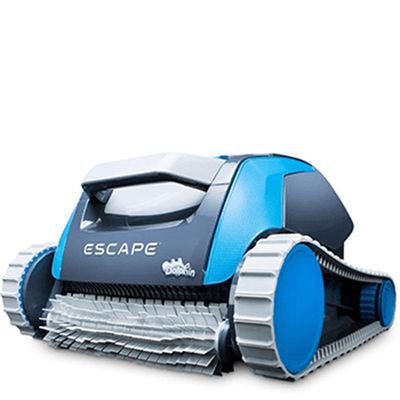
What This Budget Includes and What It Leaves Out
It helps to see both columns at once. Everything on the left comes in the box. Everything on the right costs more, either as an option or as a different robot.
The right-hand column is not a list of faults. A scrubbed tile line, phone control and a 50 ft rating belong to robots that cost considerably more. The timer is the one gap you can close without changing robots, and a caddy matters little at 14.2 lb. Decide which of these you would actually miss in a normal week, because that tells you whether this budget is enough.
Standard Escape or the Automation Timer Version
The Escape under $700 is the standard robot. You carry it to the pool, lower it in, press the button on the power supply and it runs one 1.5-hour cycle. For many owners that is all they want: clean the pool on Saturday morning, and again midweek if the wind has been up.
The optional Automation Timer power supply changes the routine. It starts a cycle every 24, 48 or 72 hours with nobody pressing anything. That version costs more, and depending on the live price it may take you past $700, so check the card. If hands-off scheduling is the main thing you want, compare it with the Cayman before deciding, since the Cayman's timer, which runs every day, is built in.
When to Step Up to the Cayman
The Dolphin Cayman is the next robot up, above this budget, and it is the same kind of machine with four practical gains. Its cable is 50 ft instead of 40, which settles the reach question on larger above-ground rounds. Its timer is standard and runs the robot every day. Its published surfaces add concrete, plaster and pebble. And its published obstacles include steps, ladders, drain covers and ledges, where the Escape publishes none.
It also keeps the same limits: a 33 ft rating and no waterline cleaning. If none of those four gains touches your pool, the Escape does the same floor-and-wall job for less.
Cable Arithmetic Before You Order
Reach is the one spec worth checking with a tape measure. The power supply has to sit back from the water's edge by the distance the manual gives. As an example only, if that setback were roughly 12 ft, a 40 ft cable would leave about 28 ft to cross the water, so use the figure in your own manual.
On a rectangle, set the power supply at the middle of a long side so the cable only has to reach the far corners. On a large round, the far side is a full diameter away. If the numbers are tight, that is your cue to look at the Cayman's 50 ft cable, or to chat with a pool expert before ordering.
Getting the Most From the Escape
- Lay the 40 ft cable out straight along the deck before every run. With no swivel, a coil left in today is a tangle next week.
- Run it two or three times a week in season. A 1.5-hour cycle is short enough to fit in before a swim.
- Rinse the MaxBin after each run and let it dry. A clean basket is most of what keeps suction strong.
- Wipe the tile line with a sponge while the basket drains. It takes two minutes and covers the one zone the robot leaves.
- Lift the robot out before shocking the pool or adding chemicals, and keep it out of direct sun whenever it is stored.