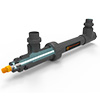
Salt water pools use salt to make chlorine.  Through the process of electrolysis, water passing over the chlorine generator cell produces chlorine.  In doing so, a salt water pool is in absolutely not chlorine free or chemical free.  The chlorine made by salt water pools is identical to chlorine purchased in stores, and will have the same effects on people and our environment.  A salt pool can be a useful too, but is by no means a green product.


Some people purchase salt systems hoping to get a pool that is free from, or at least safer than a regular chlorine pool.  Unfortunately, this is a false sense of security.  Salt water pools, like all chlorine pools cause problems such as burning eyes, skin irritations, odor, chloramines, and disinfection by-products.  New studies indicate that chlorine by-products are alarmingly dangerous.  Researchers are telling us that the impact of pool chemicals are five times greater than that of second-hand smoke.  Pools can become a toxic soup of chemicals, regardless of whether chlorine is purchased in a store or manufactured by a salt sytem.  The good news is that researchers have found a solution.  In the end, a salt water pool system can be a convenient tool, but many pool owners find a salt system can be eliminated by installing a SpectraLight Ultraviolet sterilizer and using a very small residual of regular chlorine.  This is the formula that virtually every commercial aquatic facility uses.
TV News Video Exposes Salt Water Pools
UV-pool-logo
UV-pool-logo
green council
UV is the "gold standard" - installed at over 60 leading aquatic centers & used at the Olympic Games.  UV is the proven and fastest growing alternative to chlorine and chemicals.  It's in use by over 60 major universities and municipalities.  UV sterilizers have been used to purify drinking water for over 25 years and used on commercial pools for over 10 years now.  The Olympics in Sydney and Athens embraced ultraviolet to keep their pool safe and clear.  The State of New York requires ultraviolet on all water parks.  The Centers for Disease Control have recommended UV on all public swimming pools.  Now you can eliminate chemicals using a powerful light.
"A Salt Pool Equals a Chlorine Pool"
                                   Association of Pool & Spa Professionals
Savvy Pool Owners Turn to Ultraviolet
SpectraLight UV Home
"I am allergic to chlorine and almost had to give up swimming. SpectraLight was the only product that truly lowered chlorine. 
Amy T., Fresno, CA
compare uv to salt water pools

Salt Water Pool

Are Salt Water Pools a Smart Investment?

Salt Water Pool Video

SpectraLightUV.com Home

Pool Owners Discover Commercial UV Technology

SpectraLight UV is an innovative water quality company focused on helping swimming pool and spa owners deploy advanced UV pool light technology to streamline swimming pool maintenance and minimize the use of dangerous chemicals.  Serving all 50 states and shipping worldwide.  Copyright © 2009 SpectraLight Ultraviolet,  All Rights Reserved.
Have questions? 
Need advice?
Call 1-888-895-7080
UV-pool-logo
UV-pool-logo
Site Map    |     Privacy Policy     |      Terms of Use    |     FAQ    |    Hot News     |     Buy
UV-pool-logo
UV-pool-logo
UV-pool-logo
UV-pool-logo
UV-pool-logo
spectralight-uv-brochure
spectralight-uv-testimonial

Ultraviolet is Fully Compatible with Salt Systems

If you decide to install a salt water pool system, that's no problem with SpectraLight.  There are two ways to introduce chlorine iinto a pool  Traditional store bought chlorine and the salt pool system.  The final decision is one that you should make after conducting careful research.  No matter which one you decide to go with, you will want to install SpectraLight to lower chlorine requirements and make your pool safer.  SpectraLight is fully compatible with both traditional chlorine and salt pool systems.  With SpectraLight on the job, salt water pool owners simply dial down chlorine to a safe level, about 0.5 ppm.  SpectraLight's triple action will:

    - lower the amount of chlorine needed by up to 90%
    - destroy over 60 waterborne pathogens without using chemicals
    - eliminate dangerous chloramines and chlorine by-products
What are the pros of a salt pool?

A salt water pool does offer some benefits over traditional chlorine.  First, you don't have to transport chlorine from the store.  The chlorine is made right there in the backyard.  Second, a salt pool takes less time to maintain.  There is no need to add chlorine on a weekly basis.  Although the intitial investment is substantial, a salt water pool should save 10-25% in chemical costs over a three-year period.  However, when SpectraLight Ultraviolet is installed, the savings over traditional chlorine disappears.  This is because SpectraLight allows you to lower the chlorine level in the pool by 80 - 90%.  SpectraLight works with both traditional chlorine and salt-based chlorine.

What is the maintenence on a salt water pool?

Salt water pools have a cell which is made of various metals.  There are three factors that affect how much trouble owners have with keeping their salt cells free of buildup.  First, the calcium and minerals in the swimming pool affects the life of the cell dramatically.  If a pool has high mineral content, minerals tend to build up on the cell.  Second, the quality of the salt used in the salt sytems makes a big difference.  Consumer grade salt purchased in stores can come with a lot of minerals.  There minerals cause buildup.  If you do purchase a salt system, it is a good idea to purchase a high grade salt, free of minerals.

What is the evidence that chlorine and salt-based chlorine is toxic?

An abundance of credible evidence indicates that pool chlorine levels should be reduced.  A ground-breaking study presented to the American College of Sports Medicine found that exposure to chlorine levels of 2 PPM lead to constricted airways in the lungs, coughing, wheezing, and shortness of breath. Other studies found that that pulmonary function decreases when subjects are exposed to 1 PPM chlorine.  Other researchers in Belgium found that chlorine by-products irritate infants' developing airways, making them more succeptible to lung disease later in childhood.  When chlorine levels are lowered to 0.5 PPM, these problems disappeared.  To successfully lower chlorine to 0.5 without experiencing issues with algae, bacteria, and viruses, another sanitizing method must be deployed.  SpectraLight Ultraviolet is the answer.


What are the cons of a salt water pool?

Since a salt water system makes chlorine, almost all of the same cons that apply to regular chlorine apply to salt water systems.  First, there are the dangerous by-products and chloramines that result when using salt based systems.  Some salt pools have found that the chlorine-byproducts are over 10 times what is considered safe by the World Health Organization.  There is good news.  These chlorine-by-products can be eliminated with a SpectraLight UV sterilizer.  Second, an increasing number of pool builders are reporting that salt based systems are damaging pool equipement such as pumps, filters, laddders and heaters.  Salt is corrosive and will damage metal and some other surfaces. Some reports have surfaced where salt has severely damaged coping or plaster.  However, not all swimming pools have this problem with salt systems.

How do salt water pools affect the environment?

Salt water pools are harmful to our environment.  Unlike chlorine, salt does not degrade when exposed to sunlight.  It becomes very difficult to backwash filters and drain salt water pools for routine maintenence.  Some cities charge large fines for dumping salt water on the ground or into the sewer system.  Experts agree that salt kills plants and vegetation and sterilizes soil.  Salt is also harmful to wildlife.  For these reasons, some cities have banned saltwater pools altogether.  If you choose a salt pool, please dispose of salt water safely.

How can I eliminate the harmful by-products of a salt system?

SpectraLight uses a powerful ultraviolet light to eliminate over 60 waterborne pathogens, including toxic chlorine by-products.  This technology was first introduced on commercial swimming pools, where the highest water quality is a necessity instead of a luxury.  UV was used at the games in Beijing, to eliminate the burning eyes and skin irritations common to many pools.  UV is also used to purify drinking water.  The City of New York is currently building a large water purification plant.  This high-tech plant will use 12,000 UV lamps - the same type found in SpectraLIght.  UV is the fastest growing alternative sanitizer.  By 2012, it is expected that the majority of new pools will use UV as the primary sanitizer, and chlorine will become the secondary sanitizer.